mercredi, février 21, 2007

Miércoles de ceniza


Memento homo, quia pulvus es
et in pulverem reverteris.


Memoria del por-venir para hacer justicia al presente:

Ceniza para distinguir lo grande de lo pequeño,
claridad para separar lo importante de lo demás...

« [Pour savoir] distinguer l’empirique de l’essentiel [comme Hegel, lui, le savait] ».*

Habrá alguna verdad que no cambie, alguna que permanezca. Una constante. Pero yo no la conozco.

*Maurice BLANCHOT, L’Instant de ma mort, s/l, Fata Morgana, 1994, p. 15.


Ciudad de México 20070221 2306 - 4 Adar 5767

dimanche, février 04, 2007

Groundhogday / La Candelaria

« As the light grows longer
The cold grows stronger
If Candlemas be fair and bright
Winter will have another flight
If Candlemas be cloud and rain
Winter will be gone and not come again
A farmer should on Candlemas day
Have half his corn and half his hay
On Candlemas day if thorns hang a drop
You can be sure of a good pea crop. »*


It seems that, at some point, people in Europe thought that the days halfway from Winter solstice to Spring equinox — i.e. in the middle of the winter, or half a quarter of the year — animals could be used for purposes different than alimentation or couture — yet, very practical and useful purposes.

It seems that German immigrants imported the custom to English North-America (this includes, of course, Canada); the first written reference we have of this celebration in the US is from 1841. It also seems that animals that hibernate are afraid of their own shadows — at least when they wake up from hibernation. And, finally, it seems that people believe cloudy humid days early in February mean that winter will be short and, paradoxically — at least for me —, warmer sunny days (like this peculiar weather we had in Mexico’s Central Basin, on February 2nd) mean harsh long winters.

Then, for me, Groundhog Day has always been — or mean — Groundhog Day (Hechizo del tiempo), a fantastic 1993 film that reflects on the passing of time, with Bill Murray and Andie McDowell in the leading roles of the story of a time loop. When I saw it for the first time (on open TV, surely on channel 5, dubbed to Spanish) it astounded me, it actually freaked me out, by showing the possibility of this bizarre — should I say “pop”? — eternal return.


Por otro lado, el día de la Candelaria sí pasa, termina, y suele olvidarse…


Candlemas (la Chandeleur, Candelota), well, however it is a holyday in the Christian calendar, the story behind the feast is all about Jewish traditions. On the one hand, in Mosaic Law, a woman who gives birth to a male child remains impure for forty days and at the end of the quarantine she has to go to the temple with her son. On the other hand, there is a peculiar and discussed translation of a prophecy delivered to the “just and devout man” who met Jesus at the temple’s entrance, Simeon the Righteous — a Christian saint con-fused with a legendary rabbi, Shimon HaTzaddik, (with two possible and debated identities, either Shimon I, 310-291 / 300-270 BCE, or Shimon II, 219-199 BCE).

It seems that Simeon’s prophecy and some other passages in the Pentateuch and in the Prophetical Books, originally written in Hebrew, present the problem of translating the word almah (עלמה), that means “young marriageable girl” — and, hence, unmarried. These details could imply that such girl would be a virgin, although almah does not literally mean that. Now, you can imagine (in fact, you may be living) the confusions provoked when the Septuagint translated almah as parthenos (παρθενος), i. e. “virgin” in greek.

According to the Orthodox Christian tradition, Simeon the Righteous was one of the seventy-two translators of the Septuagint. He hesitated when translating the word almah (as parthenos) from Isaiah 7:14,** and at that very moment he was promised by an angel not to see death until he had seen the Christ born of a virgin (by the way, his feast as a Christian saint is celebrated on February 3rd). So, when he held Jesus in his arms and recognised him at the temple, he uttered a prayer known as “Nunc dimitiis” (“Now I’m dismissed” or Now I am free, the latter is my free interpretation).

« Nunc dimittis servum tuum, Domine, secundum verbum tuum in pace:
Quia viderunt oculi mei salutare tuum
Quod parasti ante faciem omnium populorum:
Lumen ad revelationem gentium, et gloriam plebis tuae
Israel. »***


This post is difficult to explain, I somehow needed to “make” it. It took me two and a half days to put it together:

  • The illustration on top of the post is a 1478 drawing by Theodoros PELECANOS from the alchemical tract Synosius; it represents an Ouroboros and was taken from Wikipedia.
  • * The first quoted text is an anonymous Scottish poem from which derives the North-American tradition of Groundhog Day, according to Wikipedia.
  • ** For further information on Isaiah 7:14 (notice the curious numeric pattern) and on the controversy around almah, there is this Wikipedia article.
  • *** The last quoted text is the “Nunc dimitiis” prayer in its Latin version as appears on Wikipedia; for diverse english translations of the Latin text see the link.

As you can see the text owes a lot to Wikipedia, but (especially in the Candelaria part) it also contains very valuable information collected from comments of R. A. COFFMAN and from the Bible of Jerusalem (Desclée de Bower, Bruxelles/Bilbao, 1967, for the Spanish edition). I sincerely apologise for any inaccuracy, error or misinterpretation.

There is, at least, one fun cinematic referrence to the dispute about the translation and interpretation of almah in Guy Ritchie (dir.), Lock, Stock and Two Smoking Barrels (Cerdos, diamantes y dos armas humeantes), United Kingdom, 1998, 107/120 mins.


: : : . . . . . : . . . . . . . . . . . . . . . : : : . . . . . . . . . . . . . . . : . . . . . : : :


Hello again!, all fictionalities aside. I’ve been away for a while, and then I thought this day, these two celebrations, and this very post were a good way of coming back home; mostly now, when I was beginning to feel “home” stranger. So, let us make a welcome list to bring ourselves up to date:

  • The Frenchman’s visit was a total blast — really, the explosion of the unexpected —, very nice, satisfying, bouleversante, challenging, shocking. It wasn’t easy. Since then, I owe a very good post to the event and the experience… I guess I still have to find the courage that such a post would take.
  • The new seminar is huge, in every sense: it is full of people, projects and possibilities, but is also full, replete, of work and to-do’s… and I really don’t know how I will manage to complete the job properly (I’m trying though, hard).
  • People go on with their blogs and I’m far behind with my reading: I have loads of comments to post. And, by the way, a parasite publicity page has clung to this one. I never knew how or when, it just appeared overnight. I apologise for it and if anyone knows what I should do to solve the problem, please, let me know.
  • I have just bought Shemot (the “new” Mexican translation!), and still have four other quite expensive volumes to buy. While doing so, I’m trying to combine the work with it with the reading of Benjamin, Rosenzweig and Blanqui. By the way, Torah studying is becoming extremely interesting — and promising too.
  • I have just completed — with Nat — our very own ‘David Lynch’s Essential Collection’ (the central pieces are the films of the trilogy, Blue Velvet, Twin Peaks: Fire Walk with Me and Mulholland Drive). So we’re ready and looking forward to that promissed discussion on Mulholland Drive (Lizz, ¡cuándo usted quiera!).
  • And last but not least, El Colegio de México — or rather, the worker’s union, SUTCOLMEX — went on strike this Friday, February 2nd, for about five minutes. It may be silly for people who still have in mind the 1999 “student strike” at UNAM, but there was something about this mini-strike… anyway, it was exciting, everybody running, contradictory information circulating, speculations lingering and, finally, we just recovered some mosaics of the complete picture. A fine mid-winter experience.

Alas! This is the final post of the English-&-some-French series. We will be recovering other paths of communication (by the way, Blogger forced me to change to the new version of the service, so any unexpected change, error or failure, shall be due to that unfortunate event).

P. S. : Friday, February 2nd 2007, was also the 125th Anniversary of James Joyce’s birth-day. I just found about it today.

P. S. 2: I’ve already had two days to confirm that, this year, weather prediction using the Groundhog Day system seems to be accurate. Candlemas was hot, sunny, clear and windy while Saturday and Sunday have been cold, very cloudy and, surprisingly, rainy!


Ciudad de México 20070204 1647 - 16 Shevat 5767

mardi, janvier 09, 2007

LA APERTURA DE LOS CAMPOS DE EXTERMINIO NAZIS EN 1945
“Abrir los campos, cerrar los ojos”

El Seminario Políticas de la Memoria
del Centro de Poética del Instituto de Investigaciones Filológicas de la UNAM
y el 17 Instituto de Estudios Críticos
invitan a la serie de conferencias
“Abrir los campos, cerrar los ojos”
que impartirá
Georges DIDI-HUBERMAN
(École des Hauts Études en Sciences Sociales),
los días 10 y 11 de enero
en el Aula Magna del Instituto de Investigaciones Filológicas,
y el viernes 12 de enero
en la Capilla del Centro Cultural Helénico,
de las 11:00 a las 13:00 hrs.

(El Instituto de Investigaciones Filológicas se localiza en el zona de institutos de humanidades de Ciudad Universitaria, sobre el circuito Mario de la Cueva s/n. El Centro Cultural Helénico se encuentra en av. Revolución 1500, col. Guadalupe Inn. Las conferencias serán realizadas en francés con traducción simultánea al español; las rondas de preguntas y respuestas podrán ser hechas en español.)


Fotografía de la conferencia inaugural.

Les Au-revoirs


[Well, this is going to be a first and a last. The post above this one is an announcement for an academic event in the IIFL, and will be staying as the site heading for a few days. This post right here has an entirely different purpose.]

The friends came about for a few weeks and, in turns, they are all returning “home”. This is my farewell to them. And this is a view of my city five nights ago… in a farewell-hello again night.


Ciudad de México 20070109 2021 - 20 Tevet 5767

dimanche, décembre 31, 2006

La Saint-Sylvestre

I thought I wouldn’t write anything for this Night of Saint Silvestre; it consumes much of my energy and takes me really too much time. But the truth is that, lately, I haven’t been doing a lot with my time or energy, and so here I am trying to put in a few words some thoughts for you, my people out there (and here comes fictionality again), to wish you something for “the year to come” now when we have the illusion that “another year is going away.”

Maybe I have to begin by apologising —in general— for the English. Honestly, I’ve been giving up Spanish, as much as I can, at least for a while… It’s been way too painful for me, and I have this crazy impression that using —thinking, living in— something else helps to get perspective, perhaps. So, I’m truly sorry, but for the moment I’ll be writing mainly in French and English —despite the (obvious) problems they bring along.

As for this so-called “New Year’s Eve”, first I thought I’d be glad seeing 2006 fade away… Then, thanks to the courtesy of the National Geographic Channel (and thanks also to my refusal of doing just anything, whatsoever), I had the pleasure to learn that “only [sic] thirty-five per cent of world population celebrates New Year’s Eve” on December 31st and, of course, I immediately identified this percentage with the planet's Christian population. This was, evidently, an abuse of my part as even if the problem of dates and time tracking certainly has a lot to do with Christianity, the real problem behind it is the Gregorian calendar itself and, hence, the ubiquitous Euro-American domination (I have to state, also, that I've never understood this strange calendars that make the year begin and end in the middle of the winter instead of choosing an equinox or a solstice for that purpose. Though, I can’t help but seeing that the pattern is analogous of that of the twenty-four hour day, which similarly begins and ends in the middle of the night. This leads to another even more interesting pattern reflected in our time experience itself, in long and short periods: winter-night, summer-noon, spring-morning, autumn-evening… which, then, would be much more than simple metaphors). Anyway, seemingly, I can’t say but the obvious.

Indeed, the relative position of the Sun and the Earth today will be the same it was a year before and, therefore, a whole cycle will be complete… just as it will be the day after, and the day after that. The real change is that tomorrow we will be writing a higher number in the calendar position that we use to classify —and some even to count— the year. The arid, somehow useless, and absurd necessity for classification is, at most, understandable, but the counting… We, living in this Christian side of the planet, assume that the counting begins in a fictitious and arbitrary date (which, evidently, does not match the birth-date of Jesus-Christ)… It would have a lot more sense if it was a count-down to some unknown to-come… But beside the bad joke, I consider that in the Gregorian calendar, the gap between the traditional event marking the Calendar’s first year and the current conscience of its arbitrariness challenges all possible magical or even mystical feeling around this date (to-day).

Having said this, have a good year 2007 (I can’t wait for 2008!)… I really don't have the courage —or maybe I’m not hypocrite enough— to hope for anything else. I’m leaving, I’m already late to celebrate nothing, really.

P. S. : I also apologise for the bitter tone... There must be something in the air...


Ciudad de México 20061231 2015 - 11 Tevet 5767

lundi, décembre 25, 2006

Der Stern der Erlösung


« En la medianoche del mundo [la medianoche del día del Hombre] comienza la aurora del día de Dios ».

Miguel GARCÍA-BARÓ

(“La figura de la Estrella. Una perspectiva global para la lectura de Rosenzweig”, dans Franz ROSENZWEIG, La Estrella de la Redención (1921), édition et traduction à l’espagnol de Miguel GARCÍA-BARÓ, Salamanca, Sígueme, 1997, p.34.)


Cela fait déjà 120 ans, exactement, de la naissance de Franz Rosenzweig à Kassel, Allemagne —un autre juif, un autre 25 décembre, ailleurs. Il mourut un 10 décembre à 43 ans, quelque peu de jours avant son 44e anniversaire. Ainsi, il ne vécut ni la Seconde guerre ni, même pas, la chute de la République de Weimar. Pour une fois, cependant, je ne veux pas parler de la mort, mais au contraire, fêter la naissance du philosophe qui s’est donné la tâche de discuter avec Hegel et rectifier le cours d’une histoire de la philosophie qui, comme il disait lui-même, commence en « Ionie et termine à Iéna ».

L’Étoile de la Rédemption ouvre la porte de la nouvelle phénoménologie et de la nouvelle herméneutique —comme ça, au-delà d’une dispute sans fondements d’importance—, et apporte les bases de la réflexion contemporaine sur l’exil, l’identité, l’éthique, et la différence (entre autres).

Ce 25 décembre, humblement —mais pas assez, pas encore—, à la mémoire de Franz Rosenzweig !


Ciudad de México 20061225 1351 - 4 Tevet 5767

dimanche, décembre 24, 2006

La Veille de Noël

Je pensais qu’il me restaient plus de choses à dire avant ce jour —je ne sais pas combien fatidique— mais ce n’est jamais comme l’on aurait pu penser. Tout comme l’année dernière, il me faut répéter que je ne suis ni croyant, ni religieux, et surtout pas chrétien ; pourtant, tout comme l’année dernière, je répète pour tous ceux qui voudront l’entendre :

« Gloria a Dios en las alturas, y en la tierra

paz a los hombres de buena voluntad. »


Ciudad de México 20061224 1901 - 3 Tevet 5767

samedi, décembre 16, 2006

“Un socialismo para el siglo XXI”
François HOUTART


Como algunos de ustedes sabrán (y digo ustedes como si, por un momento, olvidara la carga ficcional del uso del término aquí), cuando uno empieza a hablar de política se encarrila y ya luego es difícil detenerse.

Encontré este texto en la edición del domingo 10 de diciembre de 2006 de La jornada. Es un ensayo político del filósofo, sociólogo y teólogo belga François Houtart, sobre la relectura y reconstrucción del socialismo para el siglo XXI. Considero que el texto es un buen punto de partida para nuestras reflexiones actuales y responde a nuestro interés —y, más que nada, responsabilidad— por replantear una izquierda que pueda ofrecer respuestas al mundo contemporáneo, tomando en cuenta los profundos cambios ocurridos desde el tiempo en que se trazaron los lineamientos del socialismo-comunismo clásico.

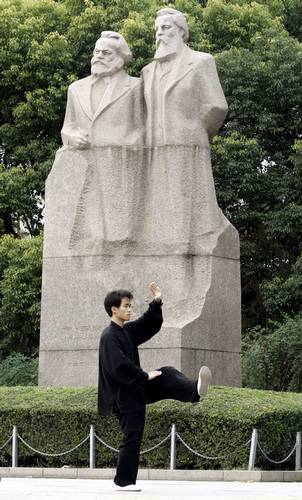
No reproduzco aquí el texto íntegro por su extensión, pero léanlo, por favor; el vínculo es éste. Para una brevísima biografía de Houtart, véase su entrada en la Wikipedia en inglés (es uno de los principales participantes en el Foro Social Mundial de Porto Alegre). Como encabezado, me tomé la libertad de presentar la imagen que acompaña el artículo de La jornada, se trata de un un hombre practicando tai-chi frente a una estatua de Marx y Engels, en Shanghai (el crédito de la fotografía es de AP).


Ciudad de México 20061216 - 25 Kislev 5767

dimanche, décembre 10, 2006

La muerte del dictador

«Is it possible that the antonym of “forgetting” is not remembering but justice

Yosef Hayim YERUSHALMI

(“Postscript: Reflections on Forgetting”, Zakor, Jewish History and Jewish Memory, New York, Schocken Books, 1989 (1982), p.117; citado por Esther COHEN en “Raconter: témoigner face au silence de la langue”, Revue Intermédialités (Raconter/Telling), núm. 2, otoño, CRI, Université de Montréal, 2003.)


Hoy, viernes 10 de diciembre de 2006 a las 14h15 (hora local), muere en Santiago de Chile el dictador y genocida, Augusto Pinochet.

Al parecer, ya hay personas congregadas tanto a la entrada del hospital militar como en la Plaza de Italia, los primeros partidarios del dictador, los segundos detractores, familiares de víctimas y desaparecidos. Luego de 17 años de dictadura y de un lento y torpe proceso de transición, la sociedad chilena sigue dividida. Como sucede habitualmente, en un principio, la división fue promovida y provocada por las fuerzas de derecha. Es imposible olvidar el cobarde asesinato de Salvador Allende y el criminal golpe de Estado que puso fin a su gobierno democráticamente electo. Por supuesto que el golpe al gobierno de Allende y la dictadura militar que le sucedió se insertan en el proceso de la Guerra Fría y en una cadena de acontecimientos políticos que, hasta el día de hoy, siguen flagelando a América Latina. Por lo tanto, la responsabilidad de los Estados Unidos ante estos hechos es ineludible; habrá que estar pendiente (aunque sólo sea para el almanaque) de la reacción oficial estadunidense frente a la muerte del dictador Pinochet.

El de Chile no es, desgraciadamente, el único caso de transiciones incompletas, deficientes y “deficitarias” en la hispanidad. El ejemplo estrella es el de la transición española incompleta y el pretendido perdón nacional (y su consiguiente olvido). Los debates a este respecto se multiplican en el mundo de habla hispana y comúnmente se suele olvidar la influencia del panorama internacional y sus correlaciones con las circunstancias locales en la instauración y la caída de las dictaduras de derecha. En el caso español, el dictador murió antes del desmantelamiento del régimen, y esta circunstancia fue aprovechada para promover cambios estructurales que no representaron un verdadero relevo de los círculos del poder, sino una mera adecuación del régimen para insertarse en el nuevo panorama sociopolítico y económico de la naciente Comunidad Europea. Con respecto a Chile, sin entrar aquí en los detalles de un complejo proceso de transición ideado desde el régimen mismo para garantizar la seguridad de sus miembros, se ha pretendido pasar de una dictadura criminal a una democracia operante y multipartidista sobre la base de una legalidad inexistente y un estado de derecho aparente, ambos con fundamentos escatológicos. Es preciso recordar que el Estado chileno contemporáneo se rige aún por la Constitución pinochetista promulgada en 1980.

Más allá de las reacciones personales y los sentimientos íntimos frente a la muerte de un criminal totalitario y asesino (insignia de la derecha latinoamericana), tengamos presente que “El Dictador” es una figura sociohistórica y economicopolítica que, en realidad, no muere. “Le roi est mort, vive le roi” es un mecanismo que aplica plenamente en el caso de los regímenes totalitarios: todos los dictadores son El Dictador. En estos momentos, sectores democráticos en Chile manejan (con mucha razón) que Pinochet muere “como fugitivo de la justicia internacional”. Nuestra responsabilidad y trabajo pendientes es abrir los ojos para continuar con nuestra lucha contra los regímenes totalitarios y antidemocráticos alrededor del mundo. El día de hoy, en lugar de dejarme llevar por la rabia de la muerte de un criminal que escapa así a la justicia, prefiero recordar nuestra deuda con el presidente Salvador Allende y con su proyecto.

Para mayor información vése el artículo “Augusto Pinochet” en Wikipedia en español.


Ciudad de México 20061210 1359 - 19 Kislev 5767

jeudi, décembre 07, 2006

Seductive Quiz

Taken from Ernesto's blog; it’s absolutely hilarious. If anyone else answers it, I fully recommend checking out the guides they offer when you finish… they're a blast. Thanx E.


Ciudad de México 20061209 1922 - 18 Kislev 5767